
Just Pick Up the Brush
What half-done work does to your nervous system (and how to close the loop)

Hi friends,
I’m writing this one late. Not because I didn’t have thoughts. Because I had too many, and they’ve been arriving in a binary way lately: either I’m hyper-focused on one thing like a dog with a bone, or I’m checked out in front of Netflix like a person whose brain has filed for temporary leave.
If you’ve been there, you know it doesn’t feel like “rest.” It feels like hiding. The news keeps talking. Social media keeps yelling. The doomscrolling has been creeping back in, the way it does when my nervous system is trying to solve a problem it can’t actually solve.
My brain believes that if I just read one more thread, one more headline, one more analysis, I’ll finally reach the bottom of the feed and find the part that says: Here is what to do. Here is how to be safe. Here is how to make it make sense.
There is no bottom.
There’s just… more.
And lately, I’ve noticed something else. There are pieces of furniture in my garage that have the same energy as doomscrolling. They sit there. They take up space. They collect dust. They stay unfinished in a way that feels oddly personal, like they’re judging me in silence. I call them my procrastination pieces: the stuff I shoved off to do in exchange for some bright and shiny project that made me feel alive for an afternoon.
They’re not even mean about it. They’re just… present. Like a passive-aggressive ottoman.
The pieces that didn’t sparkle immediately. The pieces that asked for patience. The pieces that required me to do the unsexy part first: cleaning, sanding, stripping, dealing with what’s under the surface. I’ve been avoiding them the same way I avoid certain truths. Not dramatically. Just by not looking too closely.
Here’s what I’m realizing: the things taking up space and getting covered in dust in the garage are doing the same thing the doomscrolling does in my head.
They are open loops.
And open loops are a nervous-system tax. A piece sitting in the corner saying, “Someday you’ll deal with me,” is not neutral. It’s a low hum of unfinished business. A little background hiss. A constant drip of mental clutter.
Doomscrolling does that too. It’s not just the horror of the headlines. It’s the way the information doesn’t resolve into anything actionable. It just sits there, heavy and unresolved, and then you carry it into dinner, into sleep, into your relationships, into your body.
So now I have dust in the garage and dust in my mind, and I can’t keep pretending I don’t feel the weight of both.
This is the question I’ve been circling: do I upcycle these pieces and add value creatively, or do I give them away on Buy Nothing and reclaim the space?
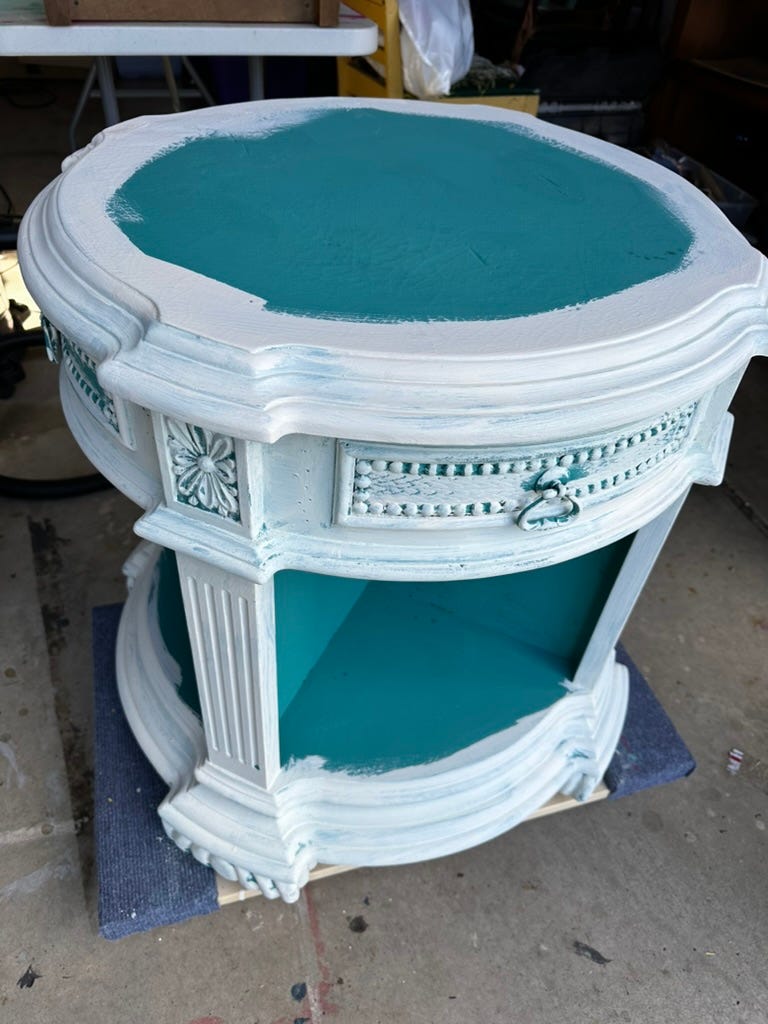
It’s not just logistics. It’s identity. Because somewhere in my head is this interrogator voice that should honestly start paying rent:
Can I add value creatively to this piece? Do I just not want to do it for some deeper reason? Am I not up to the challenge? Or is it just as simple as all I have to do is pick up a brush, put paint on it, and see if I get pulled into the creative process?
Sometimes I think I’m avoiding the furniture. Sometimes I think I’m avoiding the verdict.
Because “unfinished” is a loophole. Unfinished means nobody can judge it yet, including me. Unfinished means I get to keep my identity intact as a person who could do something amazing with this piece… someday… when I’m in the mood… when the world calms down… when my attention stops doing gymnastics.
So I’m trying something new. Instead of treating every unfinished thing as a moral trial, I’m treating it like an experiment.
Because experiments don’t require shame.
Experiments require curiosity.
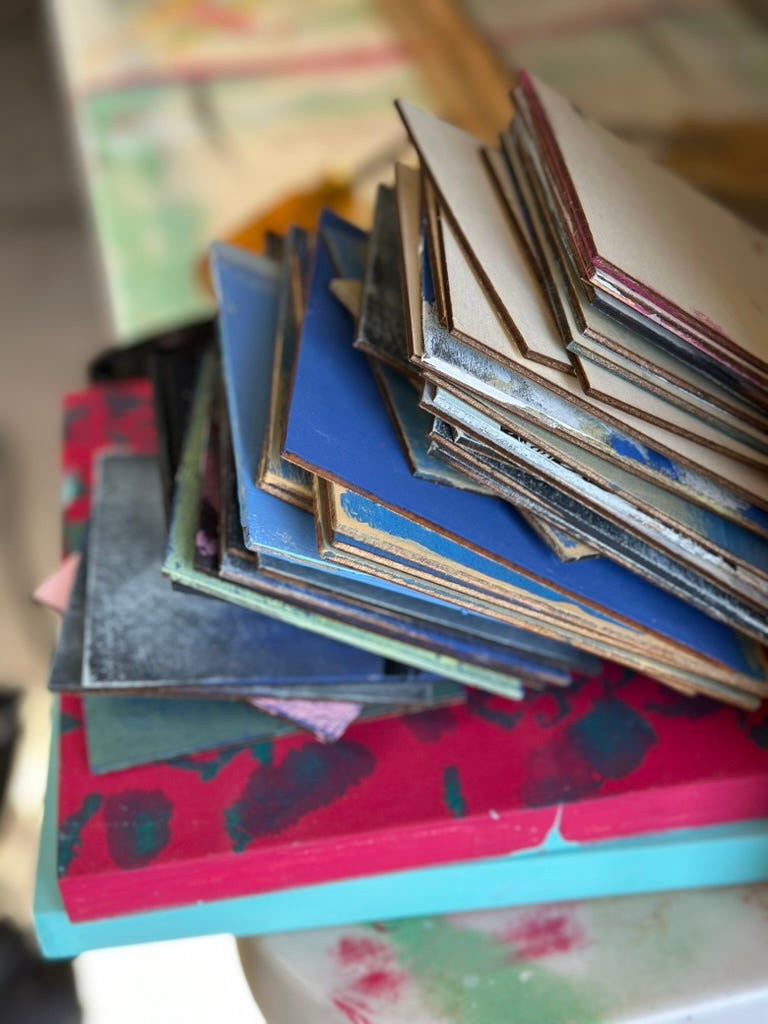
Here’s my new rule for the procrastination pieces in my garage and, if I’m honest, for my attention too: finish or release. Not “finish someday.” Not “research finishing.” Not “think about finishing while scrolling.” Finish or release....Here’s my new rule for the procrastination pieces in my garage: finish or release. Not “finish someday.” Not “research finishing.” Not “think about finishing while scrolling.” Finish or release.
Both are closure. Both are a way of telling my nervous system: we don’t have to hold everything forever.
But what about the doomscrolling? How do you “Buy Nothing” the news cycle when the open loops are in your head?
I realized I actually stumbled on the answer a couple of months ago. When I was actively going to breathwork classes, the doomscrolling just... stopped. I didn’t have to white-knuckle it or put a rigid screen-time block on my phone. Breathing simply brought me back into my body, and that physical grounding set up a kind of internal auto-prevention system.
When your nervous system is regulated, it stops frantically searching the timeline for a solution it will never find. You break the spell of the screen by remembering you have lungs. You close the loop by stepping out of it entirely.
This weekend, I worked on a piece I’d started last summer and then lost interest in. I also bought cleaning supplies for a couple of those dusty pieces. Which doesn’t sound like much, but in my world, it’s the equivalent of taking the first deep breath after holding it for too long. Cleaning a surface is not glamorous.
But it is contact.
And contact breaks the spell.
So here’s the tiny tool I’m using right now, in case you’re also living with “projects” that have turned into furniture-shaped guilt.
Pick one dusty piece in your life. Not necessarily furniture. It could be a creative project you keep postponing, a corner of your house that stresses you out, a conversation you keep rehearsing, a decision you keep “waiting to feel ready for.”
Set a timer for 15 minutes. Do the smallest, most physical first step: wipe it down, clear a surface, paint a test swatch, write the first paragraph, take one photo, make one mark.
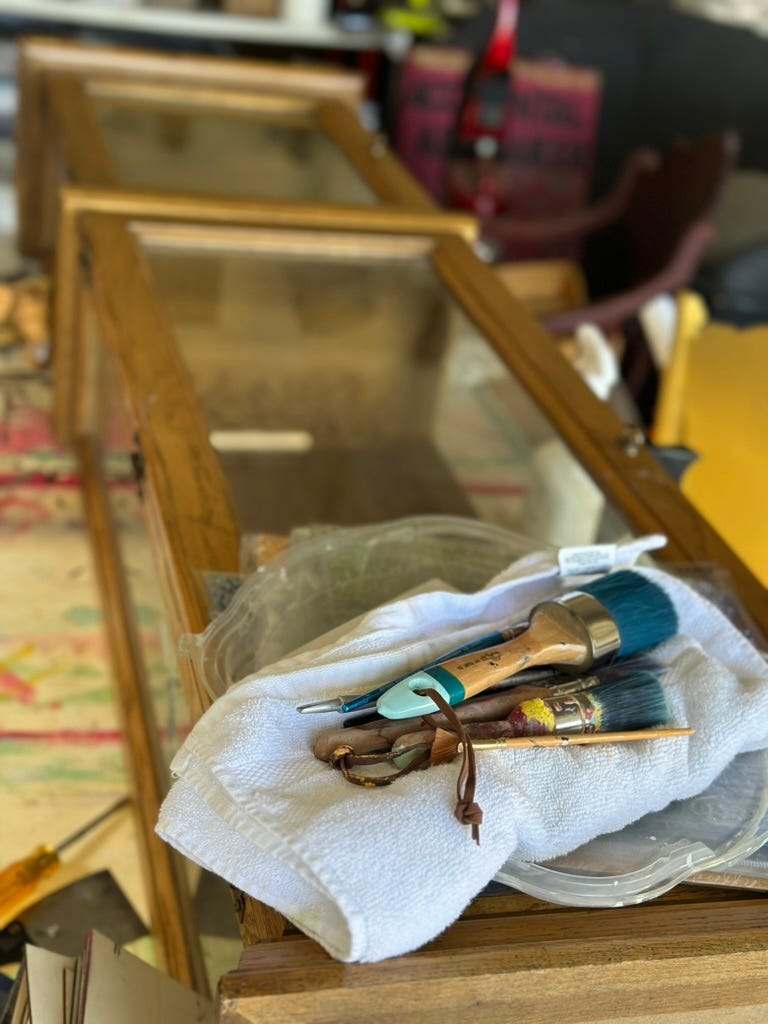
At the end of 15 minutes, ask one question: did this wake up when I touched it?
If yes, schedule one more session. If no, release it.
Because you’re allowed to stop paying the open-loop tax.
I used to think the enemy was laziness. Now I think the enemy is accumulation: the pile of unfinished things, unfinished feelings, unfinished news, unfinished care. My Second Act doesn’t need more information.
It needs more agency.
Sometimes agency looks like art. Sometimes it looks like a brush. Sometimes it looks like a trash bag and a Buy Nothing post and the holy relief of a cleared corner.
But either way, it looks like me choosing what gets to live in my space: the garage, my mind, my life.
Closing question (comments)
What’s your procrastination piece right now, the thing collecting dust in the corner of your life?
And if you gave yourself 15 minutes with it, what’s the very first step you’d take?
Warmly,
Sharon, the Accidental ArtMaker
Second Act Studio